Introduction
Ordinary observation of a photon is a destructive process. A photodetector absorbs the photon and converts its energy into an electrical signal. We learn that the photon was present, but the photon itself disappears. It therefore seems impossible to observe the same photon twice.
This limitation is not fundamental. We can let a separate quantum system interact with the field, record the effect of the photon on that system, and then measure the probe instead of the photon. The interaction has to be chosen carefully: the measured quantity must survive while some other observable of the field receives the measurement back action. Such a procedure is called a quantum nondemolition measurement.
We will consider a simple cavity quantum electrodynamics model based on the experiment of Nogues et al. (Nogues et al. 1999). A three-level atom passes through two Ramsey zones and a cavity. If the cavity is empty, the atom leaves the interferometer in one state. If the cavity contains one photon, the atom leaves in an orthogonal state. The photon is temporarily absorbed and emitted again during the interaction, so the final cavity still contains one photon.
The most important part of the construction is a phase shift. The photon does not provide energy to the final detector signal. Instead, it changes the relative phase of two atomic amplitudes. The second Ramsey zone converts this phase difference into a state that can be measured.
The Ramsey Interferometer
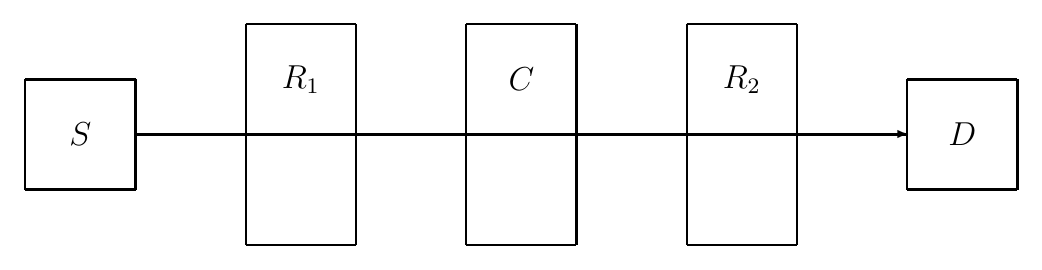
Let us start with the physical arrangement shown in Figure 1. An atom emitted by the source \(S\) passes successively through three regions \(R_1\), \(C\), and \(R_2\). The detector \(D\) measures the atomic state at the output.
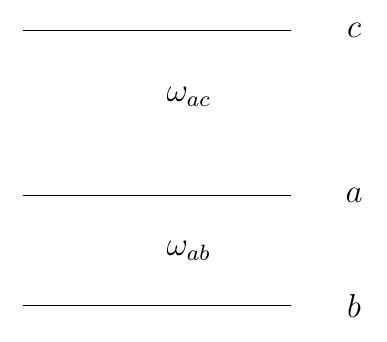
The atom has three relevant energy levels, shown in Figure 2. The Ramsey zones are resonant with the transition between \(\ket{a}\) and \(\ket{b}\), whose frequency is \(\omega_{ab}\). The cavity is resonant with the transition between \(\ket{a}\) and \(\ket{c}\), whose frequency is \(\omega_{ac}\). The state \(\ket{b}\) does not interact with the cavity field.
We want to distinguish two possible cavity states: \[\ket{0}, \qquad \ket{1}.\] The first state is the vacuum state and the second state contains one photon. We will show that the atom can distinguish these states without changing the final photon number.
Rabi Pulses
The Ramsey zones act on the two-dimensional atomic subspace spanned by \(\ket{a}\) and \(\ket{b}\). For a resonant field, the evolution can be written as follows: \[\begin{aligned} \ket{a} &\longrightarrow \cos\left(\frac{\Omega_R t}{2}\right)\ket{a} -i\sin\left(\frac{\Omega_R t}{2}\right)\ket{b}, \nonumber\\ \ket{b} &\longrightarrow -i\sin\left(\frac{\Omega_R t}{2}\right)\ket{a} +\cos\left(\frac{\Omega_R t}{2}\right)\ket{b}, \label{eq:rabi-evolution} \end{aligned}\] where \(\Omega_R\) is the Rabi frequency and \(t\) is the interaction time.
The lengths of the two Ramsey zones are chosen so that \[\Omega_R^{(R)}t_R=\frac{\pi}{2}. \label{eq:ramsey-pulse-area}\] Therefore each Ramsey zone produces a \(\pi/2\) pulse. Substituting the pulse-area condition into the Rabi evolution, we obtain \[\begin{aligned} \ket{a} &\longrightarrow \frac{1}{\sqrt{2}} \left(\ket{a}-i\ket{b}\right), \nonumber\\ \ket{b} &\longrightarrow \frac{1}{\sqrt{2}} \left(-i\ket{a}+\ket{b}\right). \label{eq:ramsey-transformations} \end{aligned}\]
In the ordered basis \(\{\ket{a},\ket{b}\}\), the transformation is represented by the matrix \[R= \frac{1}{\sqrt{2}} \begin{pmatrix} 1 & -i\\ -i & 1 \end{pmatrix}. \label{eq:ramsey-matrix}\] The first Ramsey zone thus creates a coherent superposition of two atomic paths. The second Ramsey zone will later recombine them.
The Cavity Transformation
The interaction time in the cavity is chosen differently. For the \(\ket{a}\leftrightarrow\ket{c}\) transition we require \[\Omega_R^{(C)}t_C=2\pi. \label{eq:cavity-pulse-area}\] This is a complete Rabi cycle.
First suppose that the cavity is empty. The state \(\ket{a}\ket{0}\) cannot absorb a photon because no photon is present. It is the lowest state in the coupled \(\ket{a}\)-\(\ket{c}\) subsystem. The state \(\ket{b}\ket{0}\) is also unchanged because \(\ket{b}\) does not couple to the cavity. Therefore \[\begin{aligned} \ket{a}\ket{0}&\longrightarrow\ket{a}\ket{0}, \nonumber\\ \ket{b}\ket{0}&\longrightarrow\ket{b}\ket{0}. \label{eq:empty-cavity-transformation} \end{aligned}\] On the atomic subspace, the empty cavity is represented by \[C_0= \begin{pmatrix} 1 & 0\\ 0 & 1 \end{pmatrix}. \label{eq:empty-cavity-matrix}\]
Now suppose that the cavity contains one photon. The component \(\ket{a}\ket{1}\) can absorb this photon and enter \(\ket{c}\ket{0}\). During the complete Rabi cycle it returns to the initial state, but its amplitude changes sign: \[\ket{a}\ket{1} \longrightarrow \cos(\pi)\ket{a}\ket{1} -i\sin(\pi)\ket{c}\ket{0} =-\ket{a}\ket{1}. \label{eq:one-photon-rabi-cycle}\] The final state still contains one photon. The component \(\ket{b}\ket{1}\) does not interact with the cavity and remains unchanged. Thus \[\begin{aligned} \ket{a}\ket{1}&\longrightarrow-\ket{a}\ket{1}, \nonumber\\ \ket{b}\ket{1}&\longrightarrow\phantom{-}\ket{b}\ket{1}. \label{eq:one-photon-cavity-transformation} \end{aligned}\] The corresponding atomic matrix is \[C_1= \begin{pmatrix} -1 & 0\\ 0 & 1 \end{pmatrix}. \label{eq:one-photon-cavity-matrix}\]
The difference between \(C_0\) and \(C_1\) is only a relative phase. No atomic population is changed after the complete cavity interaction. Nevertheless, the Ramsey interferometer can make this phase observable.
An Empty Cavity
Suppose that the source prepares the atom in the state \[\ket{a} = \begin{pmatrix} 1\\0 \end{pmatrix}.\] If the cavity is empty, the complete atomic transformation is \(R_2C_0R_1\). The two Ramsey zones have the same matrix \(R\), so we obtain \[\begin{aligned} R C_0 R\ket{a} &= \frac{1}{2} \begin{pmatrix} 1 & -i\\ -i & 1 \end{pmatrix} \begin{pmatrix} 1 & 0\\ 0 & 1 \end{pmatrix} \begin{pmatrix} 1 & -i\\ -i & 1 \end{pmatrix} \begin{pmatrix} 1\\0 \end{pmatrix} \nonumber\\ &= -i \begin{pmatrix} 0\\1 \end{pmatrix} =-i\ket{b}. \label{eq:empty-cavity-result} \end{aligned}\]
We can also follow the state directly. The first Ramsey zone gives \[\ket{a} \longrightarrow \frac{1}{\sqrt{2}} \left(\ket{a}-i\ket{b}\right).\] The empty cavity does not change either component. The second Ramsey zone then makes the two \(\ket{a}\) amplitudes cancel, while the two \(\ket{b}\) amplitudes add. Therefore the detector finds the atom in \(\ket{b}\).
A Cavity with One Photon
If the cavity contains one photon, we replace \(C_0\) by \(C_1\). The complete transformation becomes \[\begin{aligned} R C_1 R\ket{a} &= \frac{1}{2} \begin{pmatrix} 1 & -i\\ -i & 1 \end{pmatrix} \begin{pmatrix} -1 & 0\\ 0 & 1 \end{pmatrix} \begin{pmatrix} 1 & -i\\ -i & 1 \end{pmatrix} \begin{pmatrix} 1\\0 \end{pmatrix} \nonumber\\ &= - \begin{pmatrix} 1\\0 \end{pmatrix} =-\ket{a}. \label{eq:one-photon-result} \end{aligned}\]
This time the cavity changes the sign of the \(\ket{a}\) component between the two Ramsey zones. At the output, the \(\ket{b}\) amplitudes cancel and the \(\ket{a}\) amplitudes add. Therefore the detector finds the atom in \(\ket{a}\).
We have obtained the following rule: \[\begin{aligned} \ket{a}_{\mathrm{atom}}\ket{0}_{\mathrm{field}} &\longrightarrow -i\ket{b}_{\mathrm{atom}}\ket{0}_{\mathrm{field}}, \nonumber\\ \ket{a}_{\mathrm{atom}}\ket{1}_{\mathrm{field}} &\longrightarrow -\ket{a}_{\mathrm{atom}}\ket{1}_{\mathrm{field}}. \label{eq:complete-measurement-map} \end{aligned}\] Thus the final atomic state tells us whether the photon was present: \(\ket{b}\) means zero photons and \(\ket{a}\) means one photon. In both cases the final photon number is equal to the initial photon number.
What Nondemolition Means
It is worth noting what has and has not survived the measurement. If the cavity initially contains a definite number of photons, either \(0\) or \(1\), then that number is unchanged. In the one-photon case the photon participates in a complete absorption-emission cycle, but it is restored before the atom leaves the cavity. In principle, the same photon can therefore be interrogated again by another atom.
On the other hand, a quantum measurement is not free of back action. Suppose the field is initially in a superposition \[\ket{\psi}_{\mathrm{field}} =\alpha\ket{0}+\beta\ket{1}. \label{eq:field-superposition}\] Using the measurement map above, the joint state after the interferometer is \[-i\alpha\ket{b}\ket{0} -\beta\ket{a}\ket{1}. \label{eq:atom-field-entanglement}\] The atom and the field are now entangled. Measuring the atom projects the field onto \(\ket{0}\) or \(\ket{1}\). The photon is not absorbed, but the coherence between the two photon-number alternatives is not preserved.
The experiment described by this model is therefore a restricted quantum nondemolition measurement. It distinguishes the states with zero and one photon; it is not yet a general measurement of an arbitrary photon number. This restriction is also part of the original experimental result (Nogues et al. 1999).
Conclusion
The Ramsey interferometer converts a photon-dependent phase shift into an atomic population difference. The first Ramsey zone prepares a superposition of \(\ket{a}\) and \(\ket{b}\). The cavity changes the sign of the \(\ket{a}\) amplitude only when one photon is present. The second Ramsey zone recombines the amplitudes and maps the two cases to orthogonal atomic states.
For an empty cavity the detector finds \(\ket{b}\). For a cavity with one photon it finds \(\ket{a}\). The photon number is unchanged, so the measurement obtains information about the field without using the photon as the detector’s energy source.
Thus the photon is observed through the phase that it leaves on a probe atom. This is the central idea of a quantum nondemolition measurement: preserve the measured quantity, move the information to a separate system, and read that system instead.
Discussion
Register with a username and password to join the discussion.